

Converted on the pretty green town of Jinka, south Omo is Ethiopian’s most culturally and…
SIMIEN MOUNTAINS NATIONAL PARK
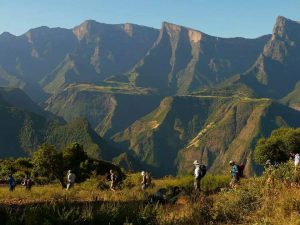 The intrepid 1920’s traveler Rosita Rosita Forbers declared it to be “the most marvelous of all Abyssinian landscapes”, waxing lyrical about its “stupendous crags” and “gorges of clouded amethyst”. Up on inscribing it as a Natural World Heritage Site in 1979, UNESCO went one further by lauding it as “one of the world’s most spectacular landscapes with jagged mountain peaks deep valleys and sharp precipices dropping some 1500m”. Ethiopians know it as the Roof of Africa, an awesome the Afro- Alpine plateau of grassy meadows and ericaceous moorlands that rises to 4533m at Ras Dejen.
Massive erosions over the years on the Ethiopian plateau has created one of the most spectacular landscapes in the world, with jagged mountain peaks, deep valleys and sharp precipices dropping some 1500m. The park is home to some extremely rare and endangered animals such as Gelada Baboon, Ethiopian Wolf and Walia Ibex, a goat found nowhere else in the world.
The Simien Mountains massif is one of the major highlands of Africa rising to the highest point in Africa Ras Dejen (4533m), wich is the fourth highest peak in the continent. Although in Africa and not too far from the equator, snow and ice appear on the points and night temperatures often fall below zero.
The national park has three general botanical regions:
The lower slopes have been cultivated and grazed, while the alpine regions (Up to 3600m) were forested, although much has now disappread. The higher lands are mountain grasslands with fescue grasses as well as heather, splendid Red hot pocker and Giant Lobelia.
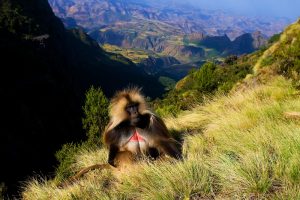
The park was created primarily to present the Walia Ibex, a type of wild goat, and over 1000 are said to live in the park. Also in the park are families of the Gelada Baboon and the rare Ethiopian Wolf. The Ethiopian although named after the mountains is rarely seen by the visitor. Over species of birds have been reported in the Simien Mountains.
Access to the park is from Debark, 101 km from Gonder, where riding and pack mule hired.
Did you know?
- The Walia Ibex was held sacred by the Pre –Axumite cultures of northern Ethiopia and is depicted on several 2500- plus year old artefacts unearthed at Yeha and other sites of similar vintage.
- The Gelada Baboon is something of a living fossil: the only surviving member of a once wide – ranging African genus of grazing monkeys ancestral both to baboons and to the drills of the western rainforests.
- The Lammergeyer is the only bird specialized in feeding on bone marrow, which comprises up to 90 percent of its diet, and is often obtained by dropping boned fro thee great heights to break them open.
- The Jewish kingdom of Bete Israel thrived in the Simien area for several centuries prior to its conquest by Emperor Susenyos in 1627.
Related Posts


